Introduction
Often, the environmental professional’s day is consumed by the daily urgent demands: a monitoring report is due, a production upset has resulted in problems with the wastewater treatment system, etc. It is all too easy to be consumed by these demands day after day. However, how do you know if you are also working on the priority issues? Periodically time is needed to evaluate the bigger environmental issues facing your facility. Described below is an exercise to provide that “pause” and think about the Environmental Big Picture for our facility.
Details
It is the tyranny of the urgent: deadlines for due regulatory reports, monitoring that needs done, production related issues, permit applications to file, budget reports to prepare, and…. The list goes on.
But how do these daily demands align with the environmental issues and priorities that need to be managed? What actions or mitigations do you need to undertake now to ensure that your facility is prepared for the intermediate and long-term environmental challenges?
At least once a year, an afternoon or day should be devoted to thinking about the big picture: what are the important environmental issues that the facility is facing and what actions should be occurring now and in the near future to prepare for them?
To aid in such an evaluation, Figure 1 provides a series of questions to define your “environmental landscape.”
Figure 1
Environmental Landscape
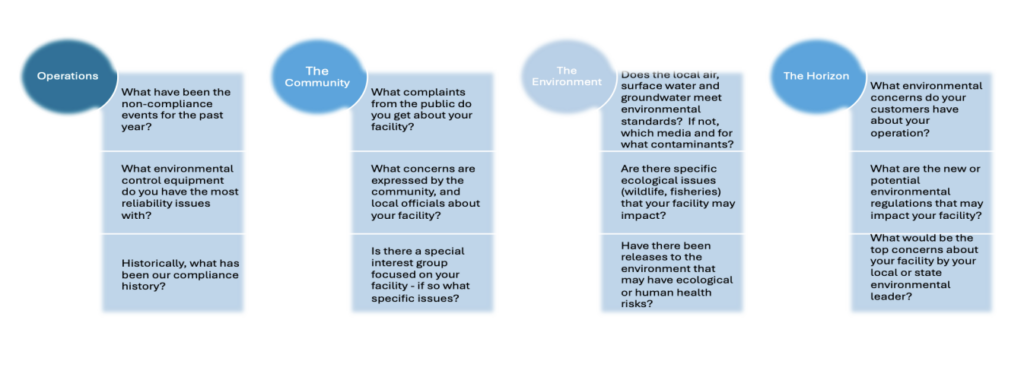
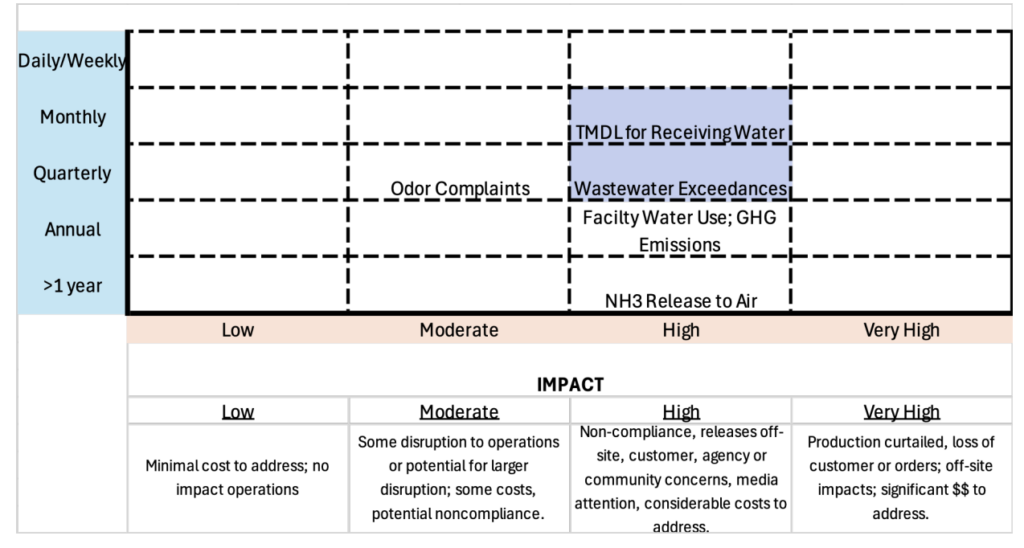
As you answer these questions, also jot down the frequency (if applicable) and to the potential impact on your operations. This information can then be plotted (Figure 2) in a matrix format.
Figure 2
Environmental Matrix
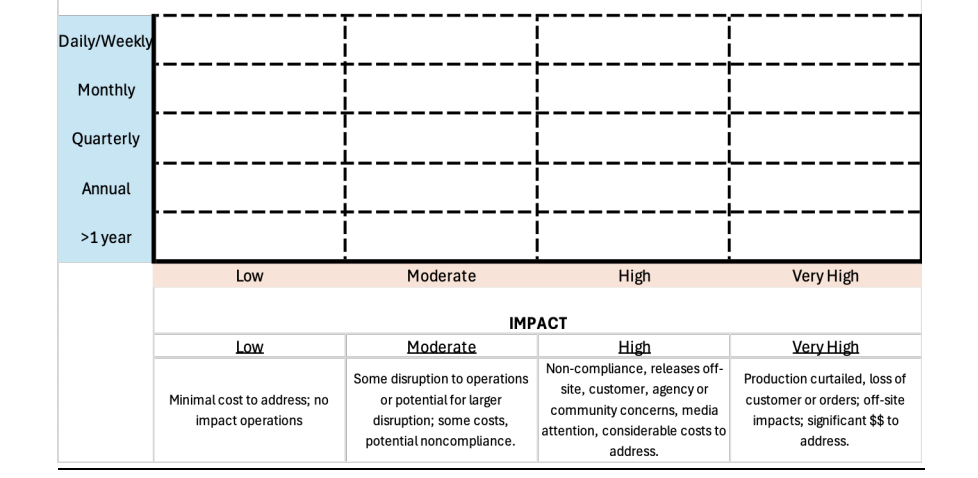
As an example, Figure 3 shows the Environmental Landscape for a hypothetical food processing facility located on the outskirts of a community and has a discharge to local river.
Figure 3
Environmental Landscape Results
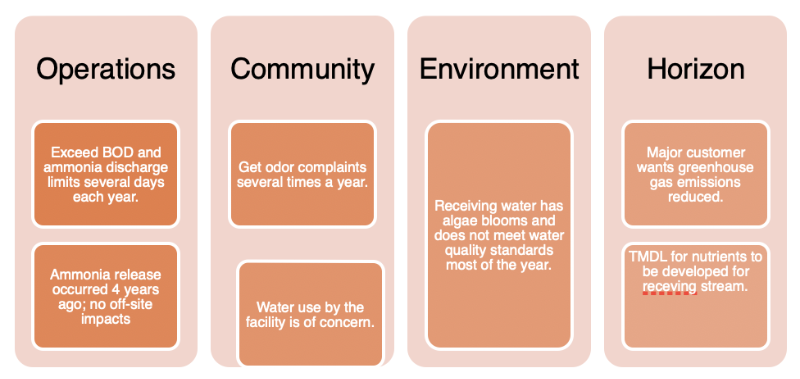
Using the information gathered from the Environmental Landscape Questionnaire, the Environmental Matrix (Figure 4) shows some commonality among the issues. Specifically, the wastewater discharge and the operation of the wastewater system. Clearly, work will be needed in the future to improve compliance assurance with the wastewater discharge permit and also to reduce future discharges once a TMDL is put in place. Such changes will likely require substantial capital, could increase operating costs (including energy use and additional solid waste generation), and may impact production. This is an issue in which further analysis of loadings to the wastewater treatment plant, options for treatment changes and perhaps additional data gathering in the receiving water could help generate options that could identify the most cost effective and beneficial way to address this issue.
Figure 4
Environmental Matrix Results
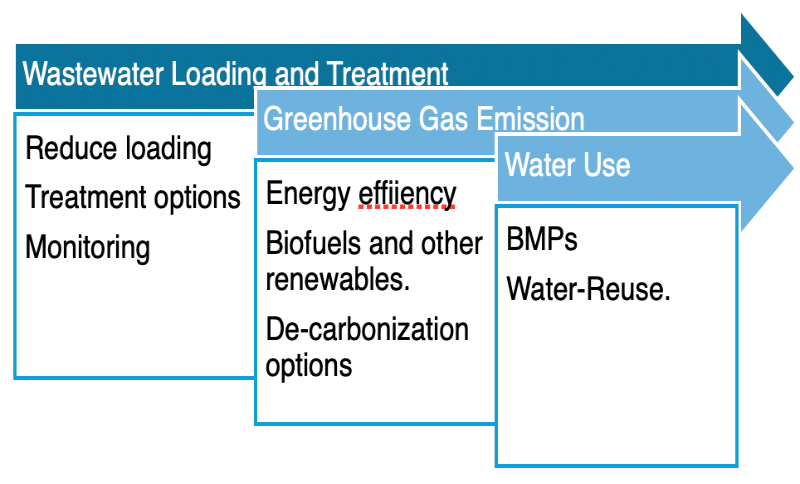
A potential ranking of priorities is in Figure 5. Note: there may be options in which adjustments to your wastewater treatment system might provide ways to reduce water use (increase the level of wastewater treatment so that the water can be reused and reduce fresh water consumption) or to generate a bio-fuel to reduce natural gas use. Thus, the solution implemented to address the wastewater treatment operation and local water quality may also provide a solution or partial solution to these other environmental challenges.
Figure 5
Priorities
Summary
The reality of setting priorities for environmental work is that it is more complex than the simplified example given. However, there is a benefit to going through such an exercise periodically. It results in identifying those issues not only being dealt with today but those coming. And it provides the opportunity for discussions on how the options for dealing with one issue might be able to help resolve another. Typically, the more time one has to research such options, the greater is the opportunity to develop a solution that works best for the facilities operations and its future.